September 2, 202611 min read
Why doesn't offering the first one free win the client?
Thom Van Dycke · Van Dycke Strategic Business Architecture
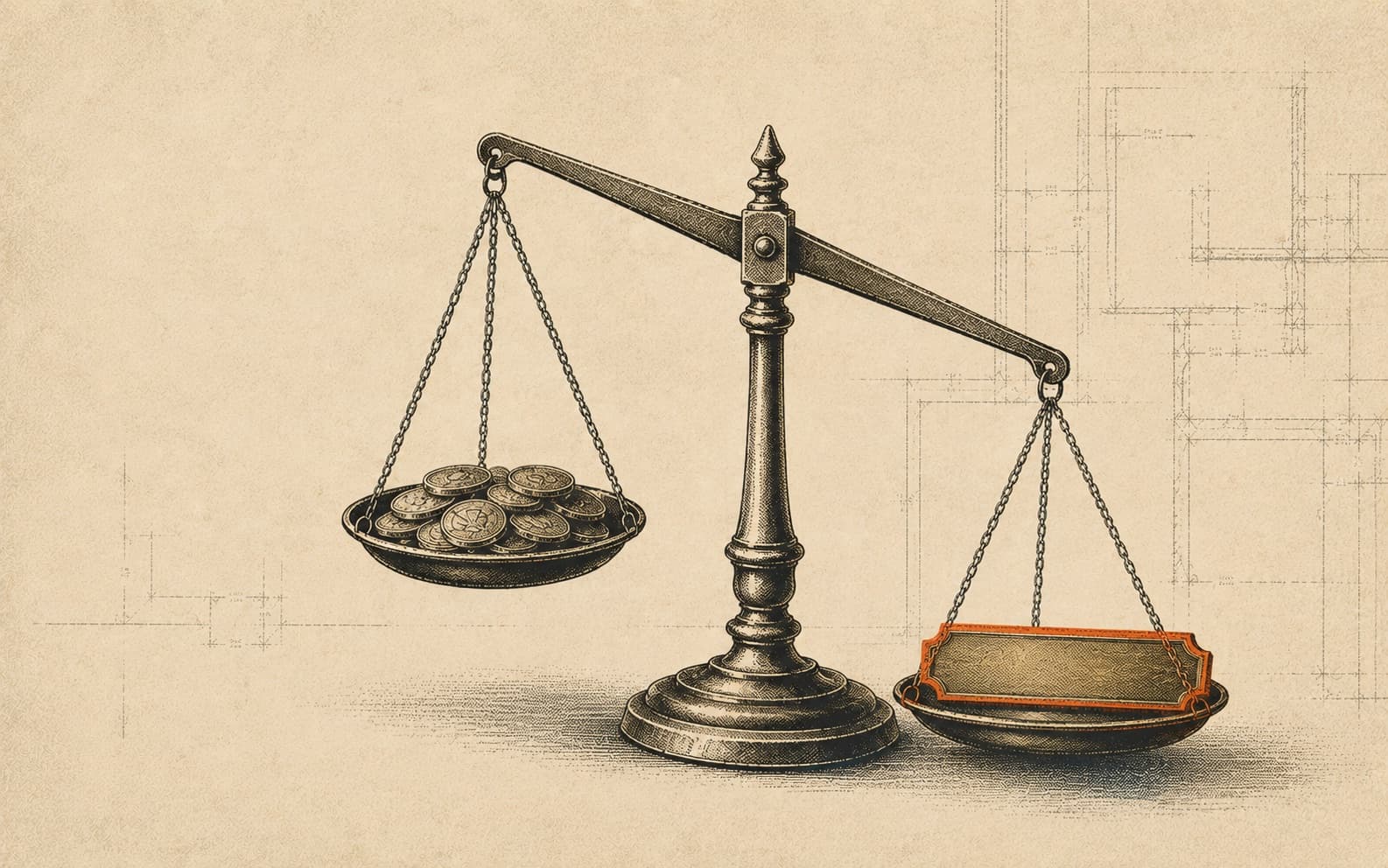
Free doesn't win the work because money was rarely the obstacle. For a founder buying anything that touches a live client, the real cost is reputational and it doesn't move with your price. Make the first purchase small and low-exposure instead of free, and let them watch how you behave before anything of theirs is at risk.
Where does taking the price to zero genuinely work?
It works, and it works better than almost anything else, when the buyer's exposure really is money.
That's worth establishing before I take it apart, because the people who built the free-trial playbook had the research on their side. Kristina Shampanier, Nina Mazar and Dan Ariely ran a set of experiments on demand at a price of zero, published as Zero as a Special Price (Marketing Science, 2007). People chose between a cheap chocolate and a good one. When both prices dropped by a single cent so the cheap one became free, demand didn't shift a little. It inverted. And cutting the good chocolate's price five times further, while the other stayed free, changed almost nothing. A one-cent cut that reaches zero moves more demand than a five-cent cut that stays above it.
Zero behaves like a category rather than a number. If you sell something a person buys with their own money for their own use, use that.
Then somebody carried it into founder-led services, where the buyer isn't spending their own money and the thing at risk isn't the fee.
What is the buyer actually paying?
Their name, and their Thursday afternoon.
A studio owner reading a white-label pitch that offers the first client free is not doing the sum you think he's doing. He's imagining handing part of a live relationship to somebody he's never met, and then imagining week three, when you go quiet and he's the one on the phone explaining it to his client. That call costs him the same whether he paid you four thousand dollars or nothing. It might cost him the client. It definitely costs him the hours of briefing you, checking your work, and covering for you if it slips, and those hours are identical at every price you could name.
So the offer he actually received was: same exposure, same hours, less compensation attached if you're wrong.
I know that weight from twenty years of putting volunteers in front of other people's kids, and the phone calls that followed when one of them said something careless. Whatever that person said, my ministry had said. When you send somebody out under your name, that person becomes you.
Your buyer knows this about himself even if he's never said it out loud, and it makes him careful in a way that looks like indifference from your side of the table. In Forrester's Business Trust Survey, 43% of B2B buyers admitted they make defensive purchase decisions more than 70% of the time, choosing the safest option over the best one, and fewer than a third are risk-tolerant (Forrester, Are B2B Buyers Cowards?). Forrester's own read is that this is rational, because these buyers decide on behalf of other people and carry the consequences personally.
Now put a discount in front of a defensive decision-maker. It doesn't touch the exposure he's defending against, and it often raises his estimate of the risk, because he's started wondering why the work is free and every answer he can think of is unflattering.
Why does a referral close what free couldn't?
Because a referral transfers somebody's judgment.
When a client hands you on, they aren't giving the new buyer a lower price. They're spending their own credibility to say this one is safe, which reduces the exact cost he was worried about. That's why referred work behaves differently in the numbers: Philipp Schmitt, Bernd Skiera and Christophe Van den Bulte tracked roughly 10,000 bank customers for close to three years and found referred customers carried a higher margin and churned about 18% more slowly, with the gap holding rather than fading (Referral Programs and Customer Value, Journal of Marketing, 2011).
I've written the mechanics of building that channel in how to build a referral system for a service business. The offer-design consequence is the part founders miss. If what a referral transfers is underwriting, then the question for your cold offer was never how to make it cheaper. It's how to let this buyer underwrite you himself, quickly, without putting his name on anything.
That's a different design problem, and it has a much better answer.
The kid I didn't plug in
I taught guitar for years, and a kid named Cody walked in around eighth grade. He'd been noodling on his own and the first time I sat down with him I thought, this kid has serious talent.
Within three weeks he was on stage leading worship at our youth group. I didn't plug him in for another three.
He was up there with the band. Real stage, real room, real songs, hearing himself, learning what happens when forty people sing along and the drummer speeds up. His amp wasn't connected to anything anybody could hear. We did versions of that constantly. A student who could sing but couldn't reliably hold a tune got pulled right down in the mains and left up in their own monitor, so they could hear themselves and nobody else was distracted.
The part that matters for your offer is easy to read the wrong way round, so I'll be exact about it.
You are not Cody in this story. You're me.
Your buyer is the one holding the mixing board. He's already decided you can probably play; that's why he read the pitch at all. What he hasn't decided is whether you'll fit his room, and he has no cheap way to find out, because every option you've given him runs your signal straight through his speakers in front of his own audience.
So build him the unplugged version. Real work, real stakes for you, real information for him, on a night where a bad decision costs him nothing.
What should the first purchase look like?
Small, paid, and pointed at something the buyer owns rather than something his client owns.
- The free pilot on his client's account. Cost to him: his name, his hours, his client relationship. Cost to you: your fee. He carries all of the exposure and you've removed the one part he wasn't worried about. This is the one that gets ignored.
- A small paid piece of work on his own property. His website, his positioning, his internal process, his own campaign. Cost to him: modest money and a couple of hours. Nobody else's money is at stake, nobody sees it if it's mediocre, and he gets to hear how you talk when a decision is real. This is the one that converts.
- The full engagement, cold. Cost to him: everything at once, on a stranger. Occasionally works when the pain is acute. Usually too large a first decision for a defensive buyer.
The middle option shrinks the surface area of the risk rather than the invoice, and then charges for the privilege, which is itself a signal. Somebody who charges for a small piece of work behaves like somebody who intends to be around for the large one.
Paid work also gets treated like work. Free work gets treated like a favour, lands at the bottom of everyone's list, gets briefed badly, and underperforms, which manufactures the exact evidence the buyer was afraid of.
One more thing, because we got this wrong in the youth group whenever we forgot it: put the debrief on the calendar before the work starts. Somebody has to say plainly afterwards what worked and what didn't. A first engagement that ends without that conversation has taught your buyer nothing except that you're pleasant, and pleasant was never the question.
Isn't this just a smaller version of the same discount?
No, and the difference decides how you build it.
A discount changes your price. A first purchase like this changes your architecture, because you're deciding which risk you're willing to hold first and designing a product around that decision. It's a positioning question about what you're the safe choice for, and it resolves into lifetime value, since the buyer who bought the small thing and watched you work is the one who refers you eighteen months later.
It also can't be copied off somebody else's playbook. What the small thing is depends on what your buyer is actually afraid of, and a bookkeeper's buyer, a fractional CMO's buyer and a commercial roofer's buyer are afraid of three different things. The principle transfers. The product doesn't. That's most of what we do with founders, and it's why I won't hand anybody a template for it.
What it costs to keep sending the free version
The failure mode is quiet, which is why it survives for years.
You send the free-trial pitch. Nobody replies. You conclude the market is saturated, or buyers are cheap, or your pricing is off, so next quarter you make the free thing bigger, and now you're doing two months of unpaid work for strangers who still aren't replying. The offer never gets diagnosed, because silence gives you nothing to diagnose. Meanwhile the two clients you did win both came from someone who vouched for you, and you filed that under luck.
The unpaid delivery is the cost you can count. The one you can't is the eighteen months you spent solving a pricing problem you didn't have.
Putting it to work
Take your current entry offer and answer these on paper.
What does this ask the buyer to risk that isn't money? Name it specifically. Their client relationship. Their internal credibility. Their team's time. Their standing with a boss or a board. Write the sentence they'd say to themselves at 11pm.
Does my offer reduce that, or only the fee? If the honest answer is only the fee, you've found it.
What's the smallest paid thing someone could buy from me where nobody else's money is at risk? On their property, not their client's. Under a week of work. Priced so the decision is small but real. If nothing like that exists in your business, that's the build.
Would I sell it to somebody who'd never heard of me? If not, it's still too big.
What does the buyer get to hear during it? How you talk when a decision is real, how you handle being wrong, whether you sound the same in the room as you did in the pitch. Design that in deliberately. It's most of what they're buying and it's the one thing they couldn't check in advance.
Who gives the feedback afterwards, and when? Book the debrief before the work starts.
Adapt it. An accountant, an agency owner and a specialty contractor will each land this differently, and the version that works is built for the specific fear your buyer carries.
Sources
- Shampanier, K., Mazar, N. & Ariely, D., "Zero as a Special Price: The True Value of Free Products", Marketing Science, 2007
- Forrester, "Are B2B Buyers Cowards?" (Business Trust Survey, 2023)
- Schmitt, P., Skiera, B. & Van den Bulte, C., "Referral Programs and Customer Value", Journal of Marketing, 2011
Frequently asked
Do free trials ever work in professional services?
They work when the buyer's exposure is genuinely just money and time they control, and when the trial is small enough to assess quickly. A free audit of something the buyer owns can work well. A free month of live work for their customers rarely does, because you've removed the cost they weren't worried about.
Isn't a paid pilot just a discounted engagement?
Only if you scope it that way. A discounted engagement is your normal work at a lower price, which teaches the client what your work costs and makes the increase awkward later. A first purchase is a different product with a different boundary, priced properly for what it is, ending on a defined date with a decision attached.
What if a prospect asks for free work directly?
Offer the small paid version and explain why in one sentence: free work gets scheduled like free work, and you'd rather they see how you behave when it counts. Most reasonable buyers accept that. The ones who push hard are telling you how the whole engagement would go.
How do I price a first engagement?
High enough that it's a real decision, low enough that it doesn't need a committee. In practice that means the person you're talking to can approve it without asking anyone. If your buyer has to escalate to say yes, you've built a second sales process into your first offer.
Does this apply to trades and local services too?
Yes, with a different fear attached. A homeowner's exposure is disruption, mess, and the possibility of being taken advantage of in their own house. Same design question: what's the smallest paid thing that lets them see how you work before the big job.
Ready to look at the architecture honestly?
If your entry offer has been ignored for a year, the problem is usually the risk it asks the buyer to carry rather than the price. Book the conversation and we'll look at what your first offer is actually asking for.
Ready for some serious action?
It starts with a quick 20-minute call to come up with a plan.
Get the next one in your inbox
Occasional field notes on positioning, marketing, and building a founder-led business worth running. No spam, and you can unsubscribe anytime.