
August 12, 20269 min read
Why did your best year leave you burned out?
Thom Van Dycke · Van Dycke Strategic Business Architecture
Your best year burned you out because growth arrived faster than the structure built to carry it. In a business held together by the founder, more work means more of you, at a fixed rate. Sometimes that outrunning is just what a good year does. What matters is whether you can read the signals early enough to do something about it.
What is a good year actually testing?
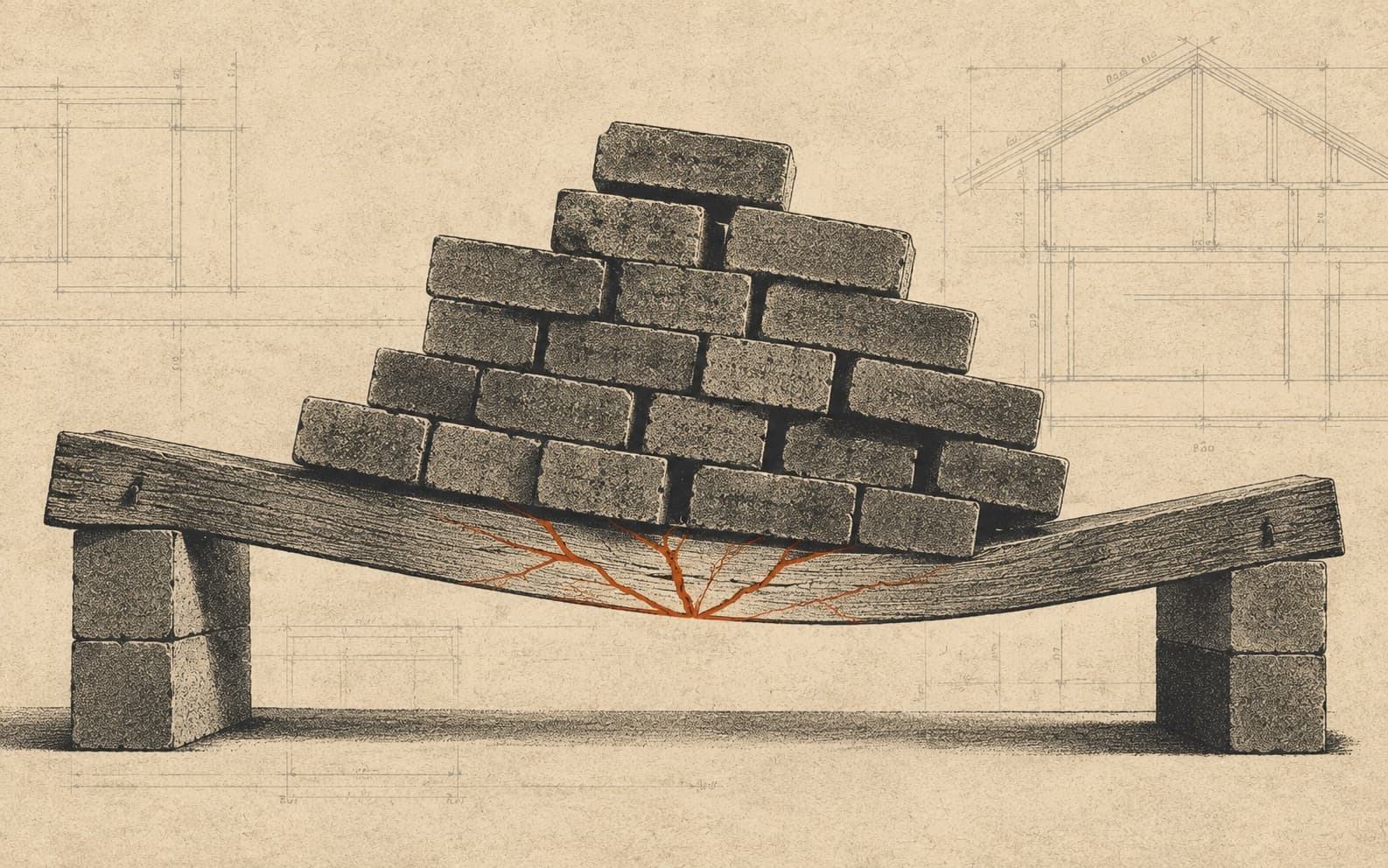
You don't learn much about a beam by looking at it. You learn by loading it.
Through the quiet years, a business held together by the founder's memory and hours looks identical to a business with real structure underneath. The difference only appears when weight arrives. One of them absorbs the weight. The other transmits every pound of it straight into the person standing in the middle.
Larry Greiner made this argument in Harvard Business Review in 1972 and it has aged better than most of what's been published about growth since. His model describes companies moving through phases of steady growth that each end in a crisis, and the crises are structural rather than personal failures. The practices that produced the growth become the thing that cannot survive it. A founder who runs every decision through himself succeeds right up until the volume of decisions overwhelms him. Working harder inside that arrangement doesn't resolve it. It arrives sooner.
But I want to be careful here, because there's a version of this argument that goes too far. Sometimes you grow faster than your structures can support and that is simply a reality of business, not evidence that you built badly. There are good years and bad years. Structure mitigates the risk; it doesn't abolish it.
What does it mean to meter growth?
This is the part I think gets missed, and it changes what you're aiming at.
When the right structure is in place, growth tends to happen consistently and predictably. You almost meter it. The business takes on what it can carry well and lets the rest go past, so the growth that does arrive is healthy and sustainable rather than a spike you survive. What it can carry well is a number, and most owners have never worked it out; the client capacity calculator puts hours against it. There will always be anomaly years where things move wildly fast. The goal was never meteoric growth. It's sustained, predictable growth, which is a much less exciting sentence and a much better business.
Metering mostly looks like saying no to work that doesn't make sense for your company. It also looks like not getting greedy, which is a plainer way of describing the same discipline.
Take construction. There is no shortage of work in that industry, which sounds like an advantage until you watch someone try to absorb all of it. Are you a renovator or a general contractor? Residential or commercial? Take everything that comes and you can no longer answer, and you will be overwhelmed very quickly, because every one of those is a different business with different crews, different margins, different sales cycles and different problems. The overwhelm doesn't come from the volume of work. It comes from having no basis on which to refuse any of it.
Which makes this a positioning question rather than a scheduling one. You can't meter what you can't refuse, and you can't refuse without knowing what the business is for.
Notice how few of the popular remedies operate here. Hire someone. Fix the margin. Bank enough to be safe. Sell the thing. Every one of those is a door out of the room, and none of them changes the rate at which work converts into your personal exhaustion. Hiring is the most common and the least understood; a strong hire needs a defined seat to stand in, which is why we wrote why you can't find and keep good people separately.
Why do feast and famine arrive as a matched pair?
In March 2023 I had the best revenue month I'd ever had as a copywriter. I had seventeen projects running at once. I worked several weekends and several late evenings, which I never do, and it was the only time in my life I seriously considered starting a copywriting agency, because I could not keep up.
By August the copywriting business had gone to zero.
Those two facts are not a story about a good year and then some bad luck. They're one structure, showing itself twice. When I was the whole system, everything that fed the pipeline stopped while I delivered, because I was delivering. Then the work ran out, because nothing had been fed. Both halves were stressful, in different ways. The feast burns you out. The famine frightens you, and the fear is arguably worse.
And the fear is what closes the loop. We eat too much when there's food around, because we remember being hungry. That's why the founder in a boom takes the seventeenth project. He isn't being greedy in any simple sense. He's making a locally reasonable decision under the memory of a drought, and in doing so he guarantees the next one.
Michael Gerber's argument in The E-Myth Revisited sits underneath all of this: most small businesses are started by technicians who are brilliant at the work and end up owning a job with worse hours and more risk than the one they left. Thirty years on it's still the most accurate description of the trap, because it locates the problem in the design rather than in the person's character.
What are the signals, before the finances know anything?
Putting my pastoral hat on for a minute, because this is the part I'd want a friend to tell me.
The first signal is almost always that you're behaving differently than you normally would. A short fuse where you used to have patience. Sleepless nights when you used to sleep through a storm. You notice yourself wringing your hands, clenching your fists. None of that shows up on a P&L and all of it is data.
The second signal lives in the commitments you've quietly stopped keeping. You said you'd be home at 5:45. Now it's 6:15, and then it's most days, and nobody made a decision about it. You promised you wouldn't work weekends and you're working weekends. Your kids are asking where Dad is, or where Mum is, and that question is a better leading indicator than anything in your dashboard.
The third comes from your people, if you've built the kind of place where they'll say it. Somebody will tell you that you look worn out and that you need a break. Trusted people around you will see it before you do, and whether that sentence ever gets spoken out loud tells you something about the business too.
Read those three as seriously as you read the numbers. They move first.
Isn't some of this just the job?
Yes, and I'd rather say so than sell you a structural fix for everything.
Burnout also comes from mindset, from emotional awareness, and from plain capacity. There is a lot of hard work in being a CEO, and no operating structure removes the weight of being the person who decides. Some seasons are heavy because the work is heavy. Treating every hard stretch as proof of a design flaw is its own kind of dishonesty, and it tends to produce founders who reorganise the business when what they actually needed was sleep, or help, or a conversation they've been avoiding.
The distinction I'd hold is this. Hard is normal. Hard in a way that keeps arriving on the same schedule, in the same shape, after every good month, is information about how the thing is built.
Putting it to work
Two exercises, and the first one isn't about the business.
Write down three commitments you made to people outside work and have quietly stopped keeping. The time you said you'd be home. The weekend you promised. The thing you told your spouse you'd stop doing. Then put a date beside each one for when it started slipping. That date is usually within a few weeks of a growth event, and finding it is the whole point of the exercise.
Now take the most profitable job or client of your past year and reconstruct it. Write down every decision inside it that could only have been made by you, then split that list in two. On one side, decisions that genuinely required your judgment, your relationships or your name. On the other, decisions that needed you because nobody has written down what a good answer looks like, or because the information only lives in your head.
The second pile is the structure you haven't built yet.
Pick the item that showed up most often across the year rather than the easiest one. Define what good looks like in writing, hand it to someone, and let it be done at 80% of your standard for a quarter. You'll want to take it back around week three, and that urge is the test rather than a signal.
And decide in advance what your next good year is not allowed to cost. Put a number on the weekends. If the only way to hit the revenue is to spend them, you've found the constraint to fix before you chase the revenue.
Sources
- Greiner, L., "Evolution and Revolution as Organizations Grow", Harvard Business Review (originally 1972, reprinted May–June 1998). Growth phases each end in a structural crisis; the practices that produced the growth are what fail under it.
- Gerber, M., The E-Myth Revisited: Why Most Small Businesses Don't Work and What to Do About It, HarperCollins, 1995. The central argument: technicians start businesses and end up owning a job.
Frequently asked
Is burnout after a record year normal, or a sign something's wrong?
Both, and separating them matters. Some of it is the ordinary weight of running a business through a heavy season. What's worth investigating is a pattern: if every good month produces the same exhaustion in the same shape, that's structural rather than seasonal.
How do I make my business run without me?
Start narrower than that phrase suggests. Separate the decisions that genuinely need your judgment from the ones that need you only because nothing is written down, then move a single item from the second group and hold your nerve for a quarter. Independence is the accumulation of many small moves.
Isn't saying no to work reckless when the work is there?
It's reckless without a basis for the decision, which is the real problem. A contractor who takes residential, commercial, renovation and new build at once isn't diversified, he's four businesses badly. Decide what you are, then refusal becomes obvious rather than brave.
What if I don't want to grow any further?
That's a legitimate strategy and almost nobody says it out loud. Holding revenue flat while rebuilding how work moves through the business is often the smartest year a founder-led company can have. It's invisible from the outside, which is exactly why so few people choose it.
Ready to look at the architecture honestly?
Book the conversation. We'll tell you what we see, and whether the work we do fits where you are.
Ready for some serious action?
It starts with a quick 20-minute call to come up with a plan.
Get the next one in your inbox
Occasional field notes on positioning, marketing, and building a founder-led business worth running. No spam, and you can unsubscribe anytime.