July 24, 20268 min read
Do you have to sell your business to be a real entrepreneur?
Thom Van Dycke · Van Dycke Strategic Business Architecture
No. You don't have to sell to prove anything. Selling is one option among several, and a good one for some owners. The claim worth throwing out is the one that says a real entrepreneur builds and sells, again and again, and that anything else isn't serious. Build a business that runs without you and you've earned every option, including keeping it.
Who decided selling is the only real entrepreneur move?
There's a story running loud right now, and it goes like this. A real entrepreneur builds a business, sells it, builds another, sells that one, and keeps flipping. That's the game. That's what the serious people do. If you're still holding the same company in ten years, you didn't win, you just got comfortable.
I want to be careful here, because build-to-sell is a fine choice. Plenty of owners build something specifically to sell it, run the play well, and walk away happy. No argument. The lie isn't the selling. The lie is that selling is the only mark of a real entrepreneur, and that keeping a business you love means you lack ambition.
That's a story someone is selling you, usually someone whose business is selling you stories. And it quietly talks a lot of good owners into treating their own company like a house to flip instead of a thing worth keeping.
Ask the question the flip-it crowd skips. What's the business actually for? If it's a lucrative company that fits the life you want and the future you're after, why would selling it be the automatic finish line? For a lot of founders, the sale trades the best asset they'll ever own for a lump sum and an empty calendar.
What does it take to step back without selling?
The same work, oddly enough, that would make it sellable in the first place.
A buyer isn't paying for your effort or your Saturdays or the fact that you happen to know which supplier to call when the usual one falls through. A buyer pays for a business that keeps producing after you walk out the door. Positioning that holds. A marketing engine that generates leads without you chasing each one. A sales process lifted out of your head into something repeatable. Clients who stay because the company delivers, not only because they like you.
That is architecture: the structure underneath the business that lets it run without the founder in every seat.
The part the flip-it story leaves out: that exact work is what lets you stay and step back. The numbers make it plain. Owner-dependent businesses are the hardest kind to sell, and when they do sell, they sell at a steep discount to companies that can run without the seller. Roughly 70 to 80 percent of small businesses listed for sale never close at all, and owner dependency is one of the most consistent reasons a deal dies. A business that can't survive the owner's absence is a job with inventory, and buyers can see it from across the room.
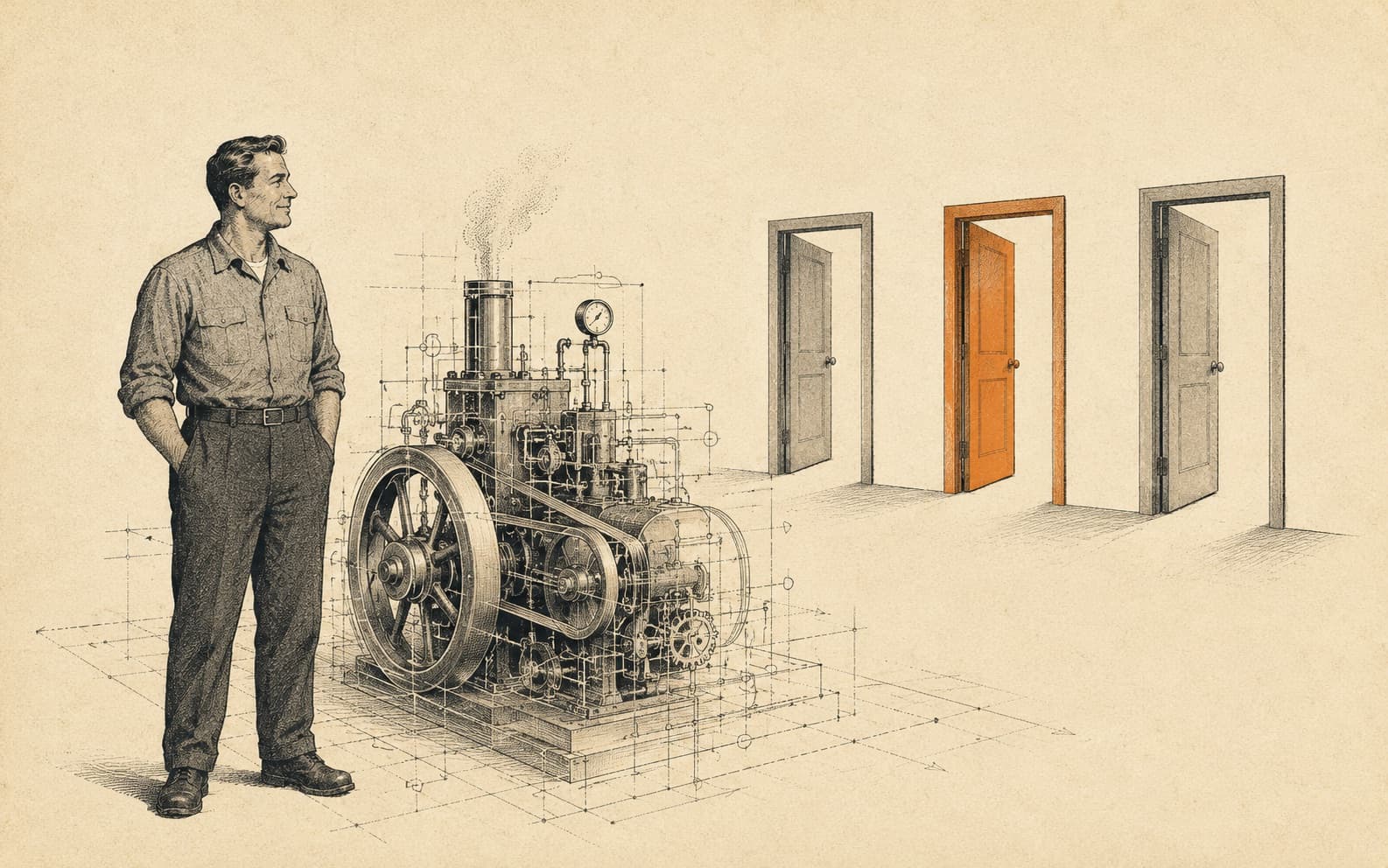
So you do the work either way. You de-founder the business, build the four systems, get yourself out of the critical path. On the day the engine finally runs on its own, you have a choice. Sell it. Keep it and step back. Keep it and go build something else with the time you just freed up. The architecture doesn't care which door you pick. It opens all of them.
What do you actually get if you keep it?
Options. That's the whole prize, and it's a bigger prize than a check.
A friend of mine, Eric, runs a siding company. He's a couple years older than me, and the business is doing well after a run of real changes the last few years. Eric is basically out of the day-to-day now. He comes in once or twice a week, talks to the team, helps them set vision and goals, and by their account cheerfully buries them in new ideas now that he has the time to dream them up.
The interesting part is what he built on the way out of the center. Eric used to run several crews, four trucks or so, all the operational weight sitting on him. He doesn't run most of those crews anymore. Instead he helps his own employees start their own businesses, then guarantees that new business by subcontracting the client work through his company. He carries the backend and the insurance. The former employee already knows the work because Eric trained them, so the quality is known. And he guarantees they get paid every two weeks, the same as when they were on payroll. For someone leaving a steady job to run their own shop, that steady pay is a huge deal. It's a genuinely good structure for both sides.
Eric didn't sell. He architected himself out of the day-to-day and kept the company. Now his options are wide open. He could start another business tomorrow. He could stay on as a slightly-removed president and advisor and keep growing this one. Or he could spend a Tuesday with his grandkids and let the engine run. None of those doors were available to him back when he was the guy in the fourth truck. He built them.
That's what keeping it can look like. Not comfortable. Not coasting. More room to choose.
Why do so many owners regret selling?
Because the sale often solves a problem they didn't actually have.
The research here is hard to ignore. According to the Exit Planning Institute's State of Owner Readiness report, roughly 75 percent of owners profoundly regret selling their business within a year of the sale. The regret rarely traces back to the price. It traces back to losing the thing the business was actually giving them: identity, purpose, a reason to get up, a place they mattered.
Read that number the right way. Plenty of owners sell and it's the right call, so treat this as a narrower point. Know what you actually want before you architect your life around a transaction. If what you want is a bigger canvas and a clean handoff, sell, and go build the next thing. If what you want is your time back with the company still in your hands, a sale is an expensive and permanent way to get something a well-built business could have handed you while you kept it.
Putting it to work
Before you take the "real entrepreneurs sell" story at face value, get honest about what you're building toward. Two questions.
First: if I disappeared for thirty days with no phone, what breaks first? Write down the specific thing. Not "everything." The actual first failure. A quote that doesn't go out. A client who doesn't get called back. A decision that sits because only you can make it. That first break is your architecture's weakest load-bearing wall, and it tells you which of the four systems to build next: positioning, marketing, sales, or lifetime value.
Second: if the business ran without me, what would I actually want to do with that freedom? Sell and start again? Stay and grow it from a step back? Take back a day a week? There's no wrong answer, and that's the point. Do the architecture work and you get to answer it yourself, instead of letting someone with a course to sell answer it for you.
Sources
- The State of Owner Readiness (Exit Planning Institute). Roughly 75% of owners regret selling within a year, largely for identity and purpose reasons rather than price.
- What Percentage of Businesses Sell? (Morgan & Westfield). Most small businesses listed for sale never close, with owner dependency a consistent deal-killer.
Frequently asked
Is selling my business ever the right move?
Yes, often. Nothing here argues against selling. The point is to know what you actually want before you do. If your goal is a bigger canvas, capital for the next venture, or a clean handoff to someone who'll carry it further, sell. If your goal is simply to stop being the bottleneck, a sale is an expensive and permanent way to get something a well-built business can give you while you keep it.
What makes a business "owner-dependent"?
The business is owner-dependent when the critical decisions, relationships, and knowledge live only in your head. Leads come because of your reputation. Deals close because clients trust you personally. Problems get solved because you solve them. Remove yourself and the machine stalls. That's a structural problem, and it's the same problem whether you plan to sell or stay.
If I'm not selling, why bother getting myself out of the day-to-day?
Because that's what turns a demanding job into an asset you own. Getting out of the critical path is what gives you a real week off, the capacity to start something new, and a business worth more if you ever do sell. The freedom and the higher valuation come from the same work. You build it once and you get to choose what it's for.
Isn't wanting to keep my business a sign I lack ambition?
No. Ambition isn't measured by how often you cash out. Building a company that runs without you and produces the life and the options you want is a serious achievement. Some of the sharpest owners hold the same business for decades and use the freedom it buys to build, mentor, or invest on their own terms.
Ready to look at the architecture honestly?
If you've built something that still runs through you, and you're being told the only serious move is to sell, book the conversation. We'll tell you what we see: which of the four systems is missing, what's keeping you in the center, and whether the work we do fits where you are.
Ready for some serious action?
It starts with a quick 20-minute call to come up with a plan.
Get the next one in your inbox
Occasional field notes on positioning, marketing, and building a founder-led business worth running. No spam, and you can unsubscribe anytime.